The authority matrix
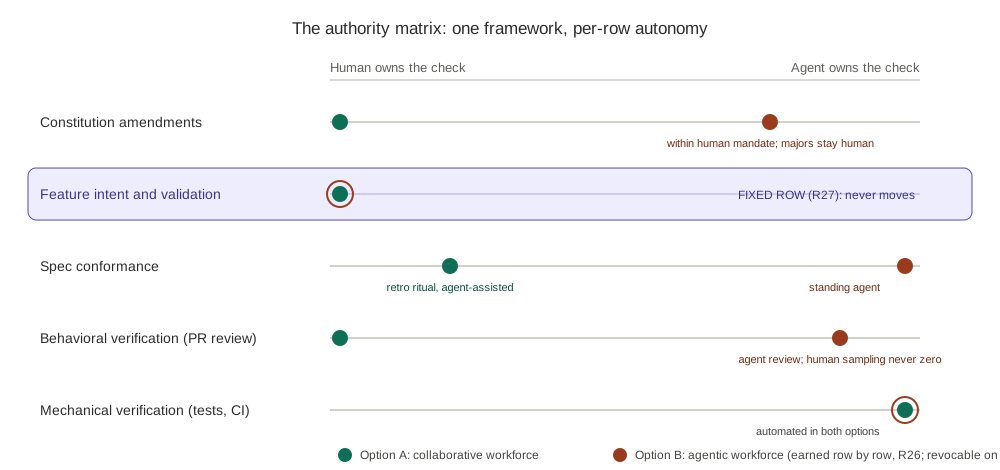
Discussions of agentic development often assume two separate modes: a collaborative one, where humans take part in every check, and a fully agentic one, where agents run the delivery. Aigile describes both with one structure. A close look at the fully agentic end shows that humans still own the intent there as well; what differs between the two is who performs each kind of check. That is a setting per checking layer rather than one big switch, and the figure below shows the layers with typical positions for both setups.
How a setting moves: a worked example
The order-system team starts with every row on the human side. In month three, the record shows 25 consecutive slices in which human review found nothing that the agent’s own checks had missed. On that evidence, pull-request review moves to agent review, with 20 percent of PRs still sampled by humans, and the change is written down as a constitution amendment with the track record attached.
In month five, a sampled PR surfaces a problem: the reviewer agent had approved a change that quietly weakened a retry criterion near the idempotency clause. This counts as an incident. The row moves back to full human review the same day, again as an amendment, and the track record starts over. The retrospective traces the cause to the reviewer prompt, which had drifted toward confirming that changes look fine instead of searching for violations, and that lesson becomes a written norm. Thirty slices later, the row graduates again, this time with 15 percent sampling.
This round trip illustrates the whole model. Authority moves toward agents on recorded evidence and returns to humans when something goes wrong, and every grant and revocation is versioned with its reasons. An organization that asks how agentic delivery is to be trusted gets a practical answer: through a written record of earned and revoked delegation.
The row that never moves
Feature intent and validation stay with humans at every state, for the reasons covered on the validation page. In a highly automated setup, the humans’ remaining work consists of three things: writing feature intents, holding the constitutional mandate, and driving demos themselves. The other rows can be earned by agents over time, and it is precisely because this one row stays fixed that the others are safe to delegate.
A hazard specific to agents checking agents
Peer review between humans works partly because two people make different mistakes. An agent that reviews the output of another agent from the same model family shares its blind spots, and can approve the same error every time. The incident in the example above shows what this looks like in practice. Setups where agents check agents therefore keep the checking independent of the building: a different model family for the reviewer, review prompts that search for violations rather than confirmation, a preference for checks that need no model judgment at all (tests, property checks), and human sampling that stays above zero. In this method, these requirements belong in the constitution rather than in a list of tips.
Full treatment: How much agents may do on their own. The practitioner guide on the downloads page walks one feature through both setups, artifact by artifact.